Answers you can verify. Memory you can defend.
Continuum answers questions about a matter's documents with a citation on every claim, built so a professional can trust and verify each statement. Its AI drives its own document search mid-answer, its data is encrypted at rest, and its quality is gated by continuous evaluation.
Ortiz held a 33.33% membership interest as of December 1, 2015 [1]. Summary judgment was granted to all defendants on April 2, 2024 [2].
- [1] Operating agreement, p. 2 Source
- [2] Order, summary judgment Source
- Grounding check Passed
- Answer model Named
- 10 Documents
- 23 Findings
What is Continuum?
Continuum is a cited AI memory for legal and financial work. It answers questions about a matter's documents with a citation on every claim, keeps a durable memory of the matter's facts and where they came from, and encrypts each matter with its own key — self-hostable, with a tamper-evident record of every change.
In legal work, a confident wrong answer isn't a bug. It's a liability.
-
Where exactly in the record does that answer come from?
Continuum answers this -
What did we know about this matter — and when did we know it?
Continuum answers this -
Who entered this fact, from which document, and has anything replaced it?
Continuum answers this -
Can a new associate pick up the matter without re-reading the whole file?
Continuum answers this -
Can we put privileged documents in without them leaving our control?
Continuum answers this -
If the record is challenged, can we prove it was never altered?
Continuum answers this
Generic chatbots answer. Continuum remembers the matter, cites every claim, and keeps a record you can defend.
Drop in the file. Let it build the picture. Confirm what it found.
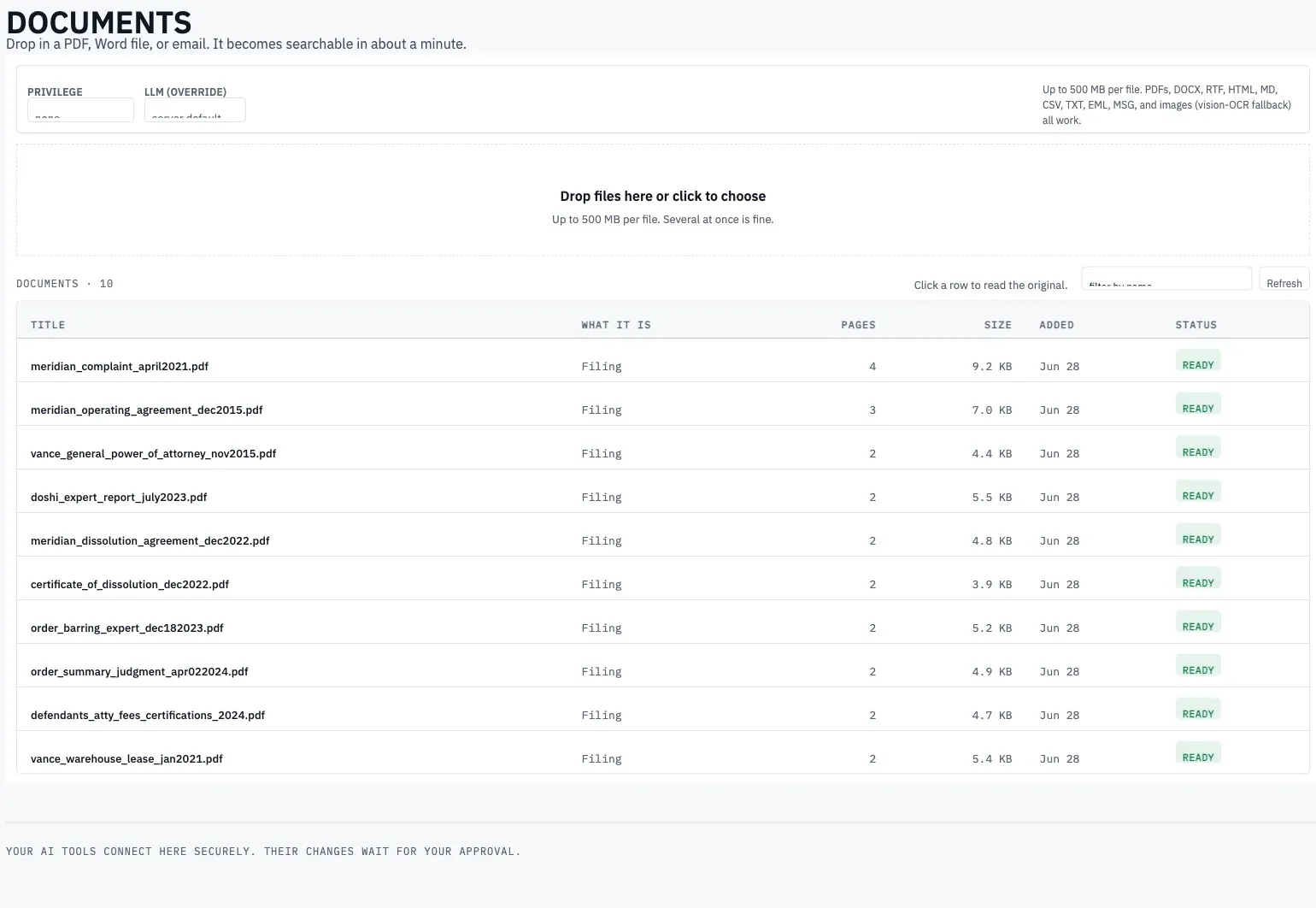
- 01 · Ingest
Drop in the file. It's searchable in a minute.
PDFs, Word files, email and images go straight into the matter — up to 500 MB each, several at once — and become searchable in about a minute. Mark privilege as you upload.
- PDF, Word, RTF, HTML, email and images
- Text recognition for scanned pages
- Privilege set at upload
- 02 · Understand
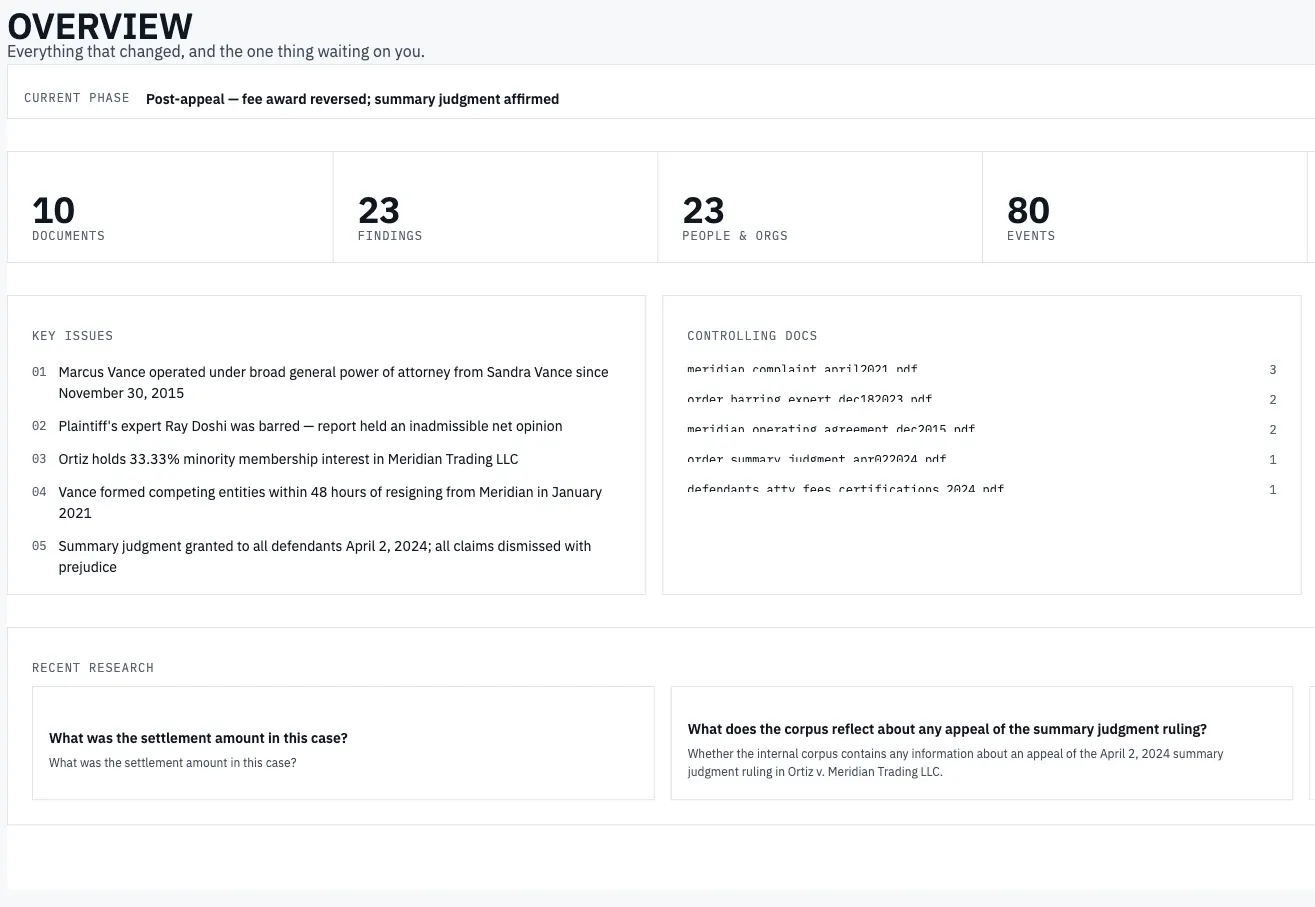
The matter, assembled from its own record
Continuum reads the file and builds the picture: the current phase, the key issues, the controlling documents and the people most connected to the case — each traceable to its source.
- Key issues drawn from the record
- Controlling documents ranked by use
- People and organisations, mapped
- 03 · Review
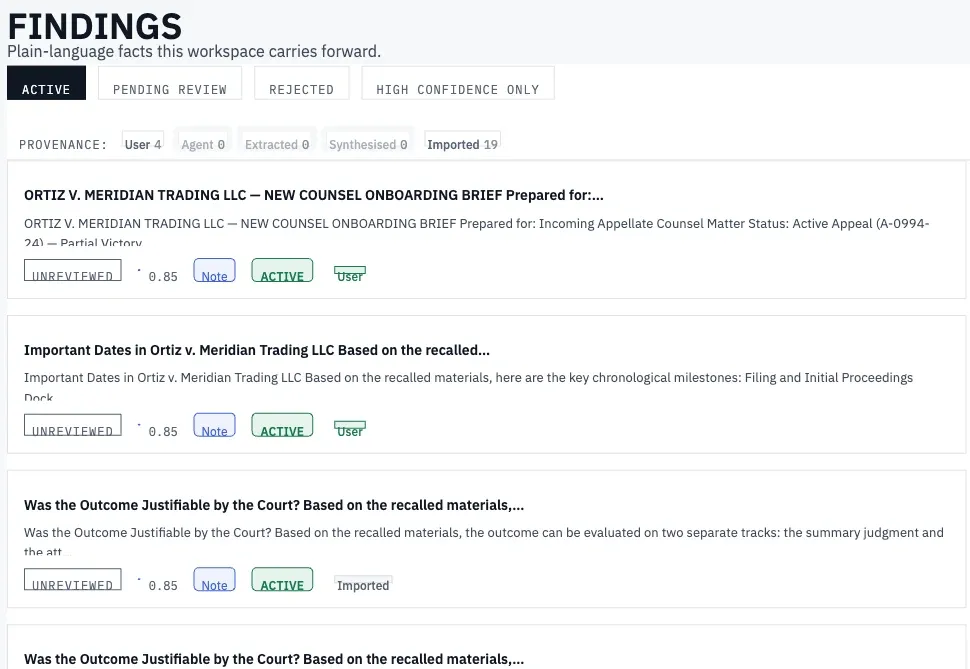
Findings a person signs off on
Facts, instructions and notes carry forward as findings, each with its provenance and a confidence score. New ones wait for review, stale ones are superseded rather than overwritten, and ambiguous names come to you to confirm.
- Provenance on every finding
- Active, pending review and rejected
- Superseded, never silently overwritten
One governed workspace per matter
Every screen reads from the same encrypted, audited matter memory — and every AI tool that connects waits for your approval.
Everything that changed, and the one thing waiting on you
The current phase, the counts that matter, the key issues and controlling documents, and the research already run on the matter.
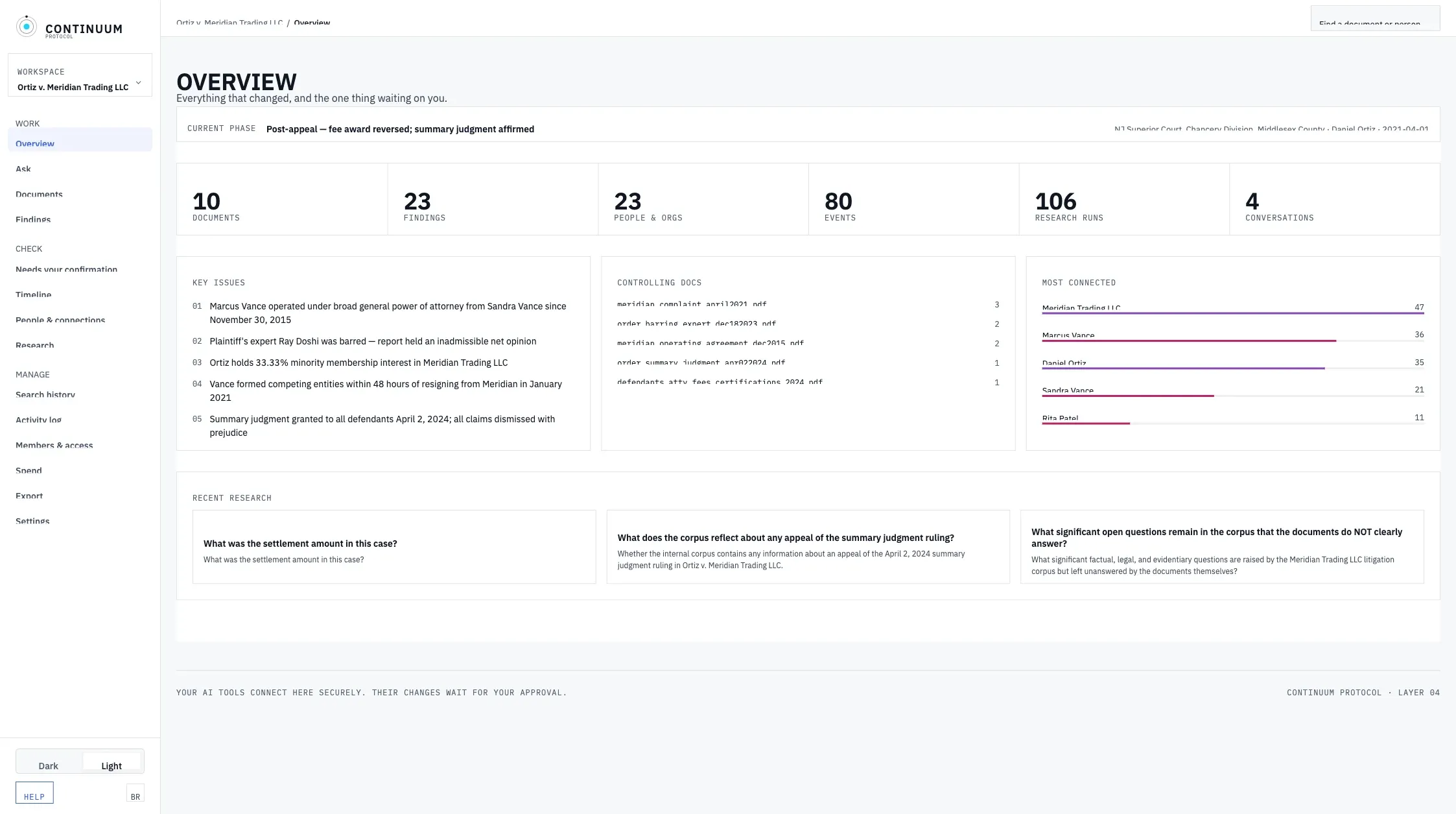 1 The matter's current phase, kept current 2 Key issues, drawn from the record 3 Research runs, saved with citations
 - 1 The matter's current phase, kept current
- 2 Key issues, drawn from the record
- 3 Research runs, saved with citations
Questions that need a written, cited answer
Search your own documents, the web, or both. Fast answers take about half a minute; Deep takes a few minutes for hard questions — and the real cost is shown after each run.
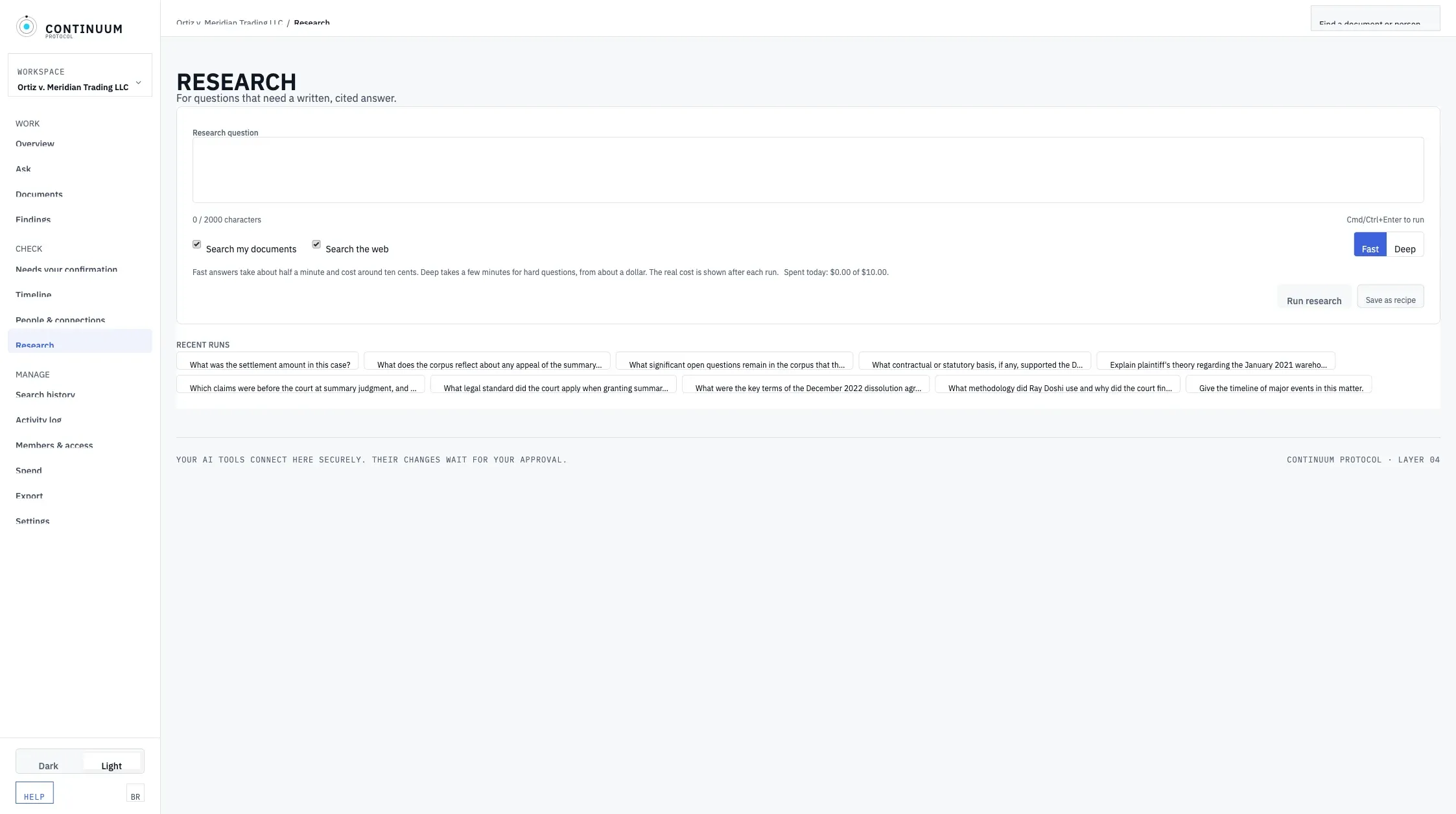 1 Ask a question that needs a cited answer 2 Your documents, the web, or both 3 Fast, or Deep for hard questions
 - 1 Ask a question that needs a cited answer
- 2 Your documents, the web, or both
- 3 Fast, or Deep for hard questions
Who can see the matter, and what they can do
Five roles, enforced by the server on every request. An AI agent never has a role of its own — it inherits the person's access, narrowed, never widened.
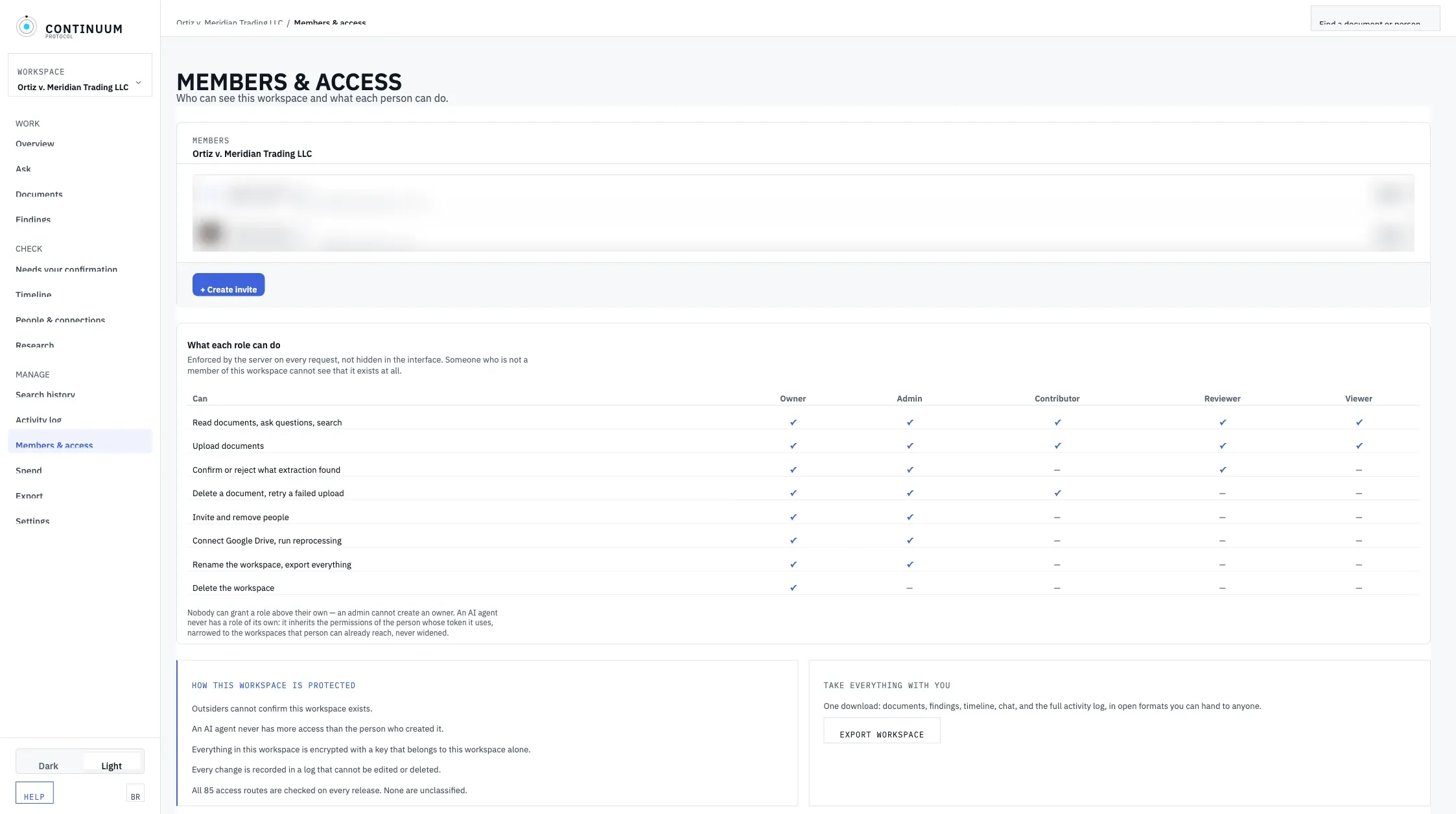 1 Five roles, enforced on every request 2 Encrypted with a key for this matter alone 3 Take everything with you, in open formats
 - 1 Five roles, enforced on every request
- 2 Encrypted with a key for this matter alone
- 3 Take everything with you, in open formats
What the AI usage cost
Every call by provider, model and action, with a monthly budget per matter. Most questions cost about ten cents.
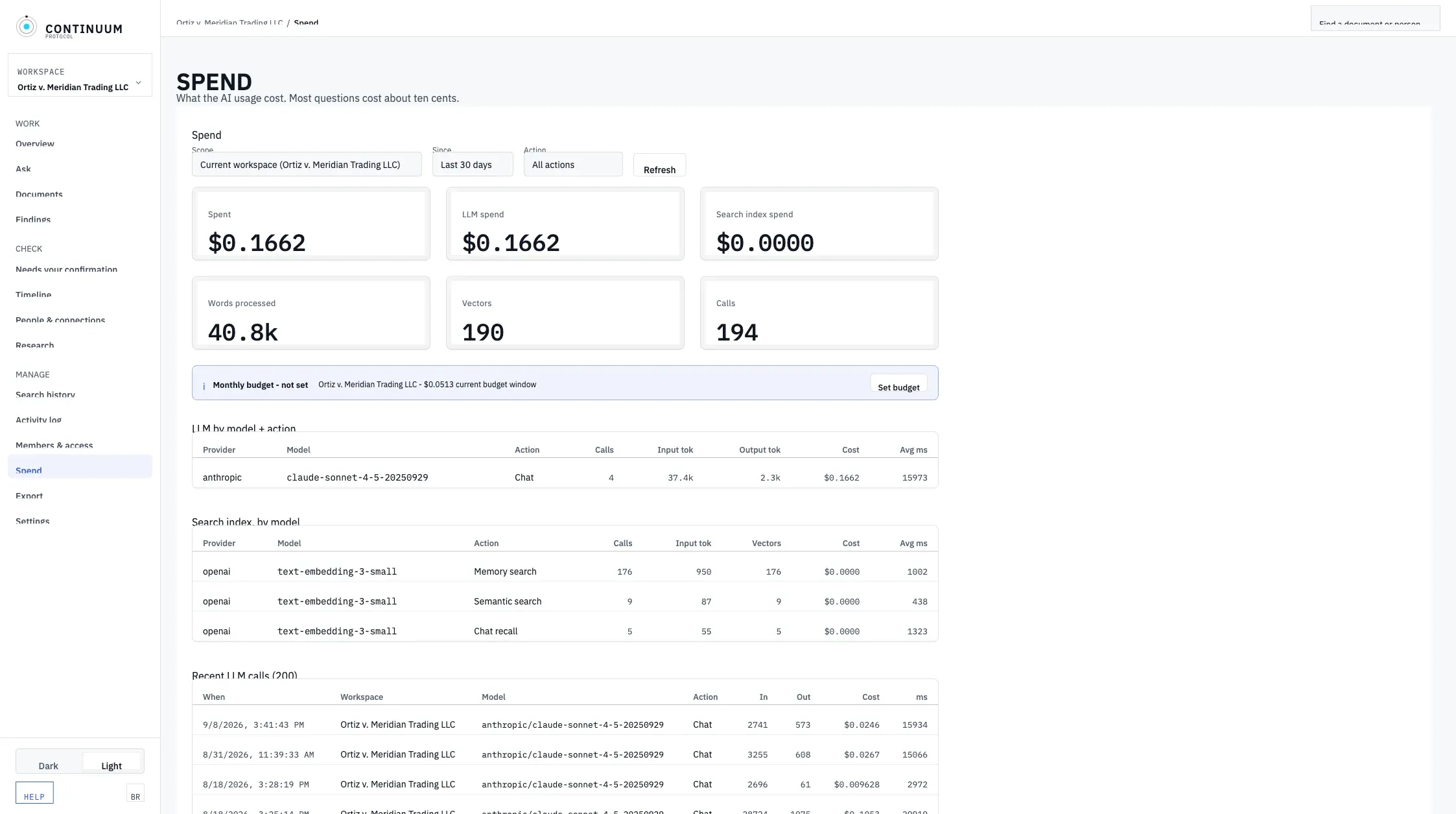 1 What every question cost, to the cent 2 A monthly budget per matter 3 Every call, by provider and model
 - 1 What every question cost, to the cent
- 2 A monthly budget per matter
- 3 Every call, by provider and model
Every claim traces to a page. Every record has its own key.
A lawyer reviews a claim against its source instead of trusting prose — and the documents behind it stay encrypted, per matter and per record, on infrastructure the firm controls.
An automated grounding gate blocks both fabrication and false “I don't know” before an answer ships.
A blind index lets keyword search run without decrypting the documents.
- 1A tamper-evident record
Every change is signed and hash-linked, and a standalone verifier proves the record was never altered.
- 2Encrypted per matter
Envelope encryption from a root key to a key per matter and per record — so one matter's data is never readable with another's key.
- 3Self-hostable, even air-gapped
Run it on your own infrastructure. Air-gapped mode refuses any cloud egress.
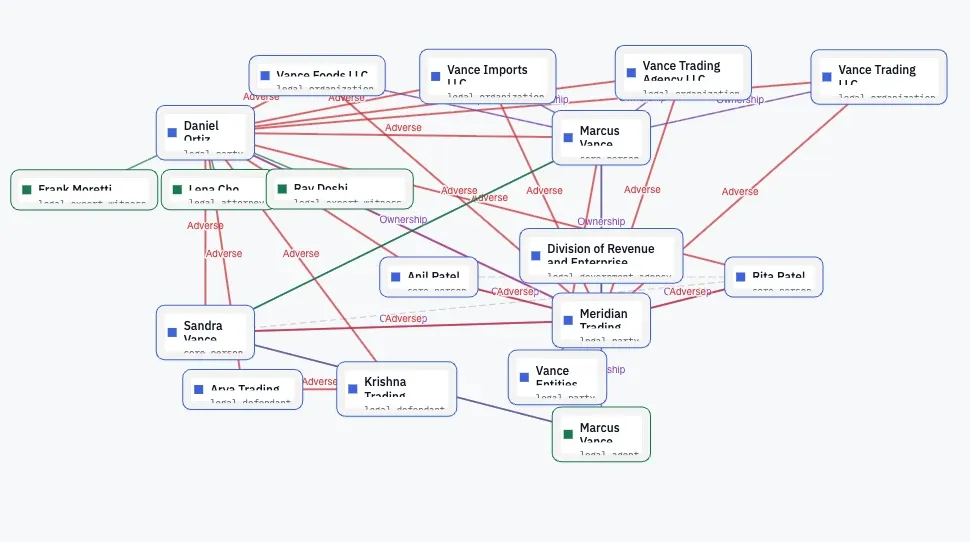
See who's involved, and what supports each claim
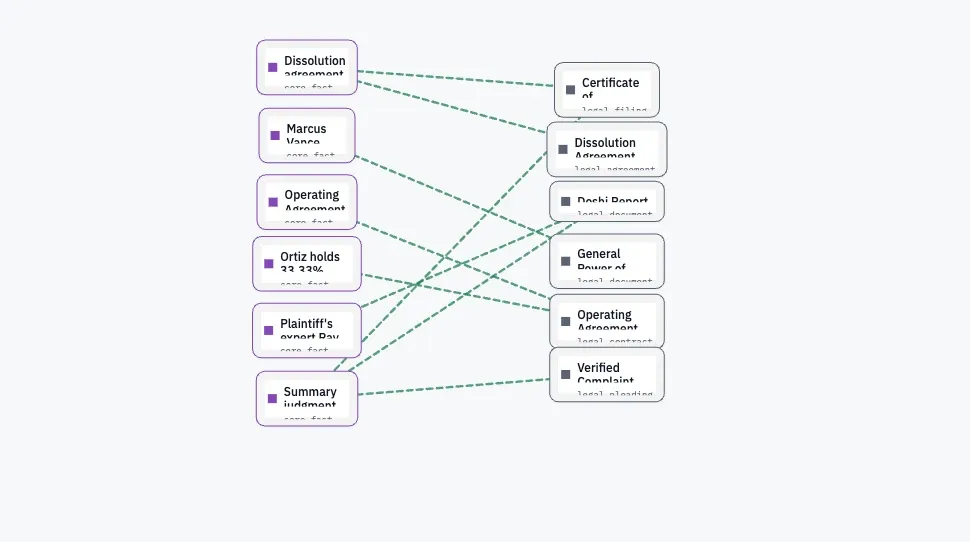
The same matter graph, two ways: the parties and how they relate, or each claim and the evidence behind it.
Parties and alignment
Every person and organisation in the matter, with ownership, representation and adverse relationships drawn from the documents.
Claims and the evidence behind them
Each claim linked to the documents that support or contradict it — so the argument and its proof sit side by side.
Your documents in. Verifiable answers out.
Your AI tools connect here securely. Their changes wait for your approval.
- PDF, Word and HTML
- Email (EML and MSG)
- Scanned pages and images
- Google Drive
- SharePoint
- Claude, Cursor and agents (MCP)
Every claim tied to a source, every change signed, every matter encrypted with its own key.
- Answers with a citation on every claim
- Findings with provenance
- Party map and chronology
- A complete, portable export
Professionals who have to stand behind the answer
- 01
Litigation teams
Brief and deposition prep where every asserted fact links to a document you can open and confirm.
- 02
Transactional and financial work
Contracts, diligence and financial files that answer with the clause or figure they came from.
- 03
Firm leadership and IT
Per-matter encryption, role-based access and an audit trail you can hand to a client or a regulator.
Questions about Continuum
How does Continuum prevent made-up citations?
Every claim in an answer carries an inline citation to the page it came from, and an automated grounding gate blocks both fabrication and false “I don't know” answers before they ship.
What kinds of files can it read?
PDF, Word, RTF, HTML, Markdown, CSV, plain text, email (EML and MSG) and images, with text recognition for scanned pages — up to 500 MB per file, and several at once.
How is client data protected?
Each matter is encrypted with its own key, derived from a root key the firm controls, and each record has its own key beneath that. A blind index lets keyword search run without decrypting the documents.
Can we host Continuum ourselves?
Yes. It's self-hostable, the root key can come from an environment secret, a mounted secret or a cloud key service, and an air-gapped mode refuses any cloud connection at all.
Who can see a matter?
Five roles — owner, admin, contributor, reviewer and viewer — enforced by the server on every request. Someone who isn't a member can't tell the matter exists, and an AI agent only inherits the access of the person whose token it uses.
What happens when a fact changes?
It's superseded, not overwritten. Continuum tracks both what was true and when the team knew it, so the state of knowledge at any past point can be reconstructed.
Can we prove the record hasn't been altered?
Every change is signed and hash-linked in an audit chain, and a standalone verifier lets an outsider confirm the record was never altered.
Does it work with the AI tools we already use?
Yes. Claude Desktop, Cursor and other agents connect over MCP, and their changes wait for a person's approval. Google Drive and SharePoint connectors bring documents in.
What does it cost to run?
Continuum records the cost of every AI call by provider and model, each matter can have a monthly budget and a daily spend cap, and most questions cost about ten cents.
How can we see Continuum on a matter of our own?
Request a demo and we'll walk through Continuum with you.
Where Continuum fits
Services
- Infrastructure & Integration Enterprise systems, integrations, and knowledge architecture: the consequential work most complexity hides in. →
- Intelligence & Advisory Confident technology decisions and disciplined AI, governed, measured, and honest about its limits. →
- Product Innovation & Venture Development Turning ideas into commercial technology, from prototype to product to venture. →
More platforms
- TIP Business and agency operations, unified. →
- Bright Commerce Commerce operations and product information. →
- SchoolTracker.ai Marketing intelligence, trusted by 300+ school brands. →
- Shepard Church management software that tells staff what needs attention. →
- Helm A live financial operating system. →